
What exactly is cocopeat, and where does ours come from?
Why our raised beds with water reservoirs need a special mix, how extensive testing led us to cocopeat, what makes ours different from ordinary coir blocks sold in shops, and where it comes from

Last year, we launched a new product: the water reservoir for our MM-hero and MM-bamboo raised beds. They work very well, and everyone is pleased with them.
But during hot, dry periods, we sometimes noticed something odd: the mix gradually dried out from the top, even though the reservoir was still full. It wasn't a major problem - you could simply add some extra water from above - but we weren't entirely happy with it.
So we set out to find out what was happening.
How we arrived at cocopeat
At first, we thought the wicks were the problem, but changing them made little difference. We then added all sorts of things to the mix and started testing other mixtures too, including mixes with a lot of cocopeat and even pure coconut coir.
We discovered that coconut coir draws water up through the wicks much faster and more consistently than brown peat fibres, even when it has dried out completely. So we continued along that path.

Why pure cocopeat isn't suitable
Pure coconut coir contains salts and has the wrong acidity for plants. They won't grow well in it. To make the fibres suitable, they first need to be rinsed and buffered.
Rinsing removes salts from the coconut coir. Salt can block the nutrients you add. Buffering brings the pH (acidity) to the right level: between 6.5 and 7. That is when plants can absorb nutrients most effectively.
Both processes are quite expensive. Standard coir blocks are therefore often only rinsed, or not treated at all. Their pH is then too low and their salt content too high. This damages roots and prevents plants from absorbing nutrients properly.
Both processes are quite expensive. Standard coir blocks are therefore often only rinsed, or not treated at all. Their pH is then too low and their salt content too high. This damages roots and prevents plants from absorbing nutrients properly.
However, a few companies in the Netherlands are known for producing high-quality coir. We ordered a large number of their (expensive!) blocks, made from fairly fine fibres. And sure enough, they drew up moisture very well.
Moist - but not too moist - and airy
But then a new problem arose: our raised beds are only 20 centimetres deep. Those fine fibres drew moisture up through the wicks so effectively that they became soaking wet from bottom to top. That wasn't what we wanted either.
All that moisture made the mixture settle and become less airy. The plants grew less and less well, and their lower leaves began to rot. We added perlite and vermiculite, but unfortunately that didn't improve matters.

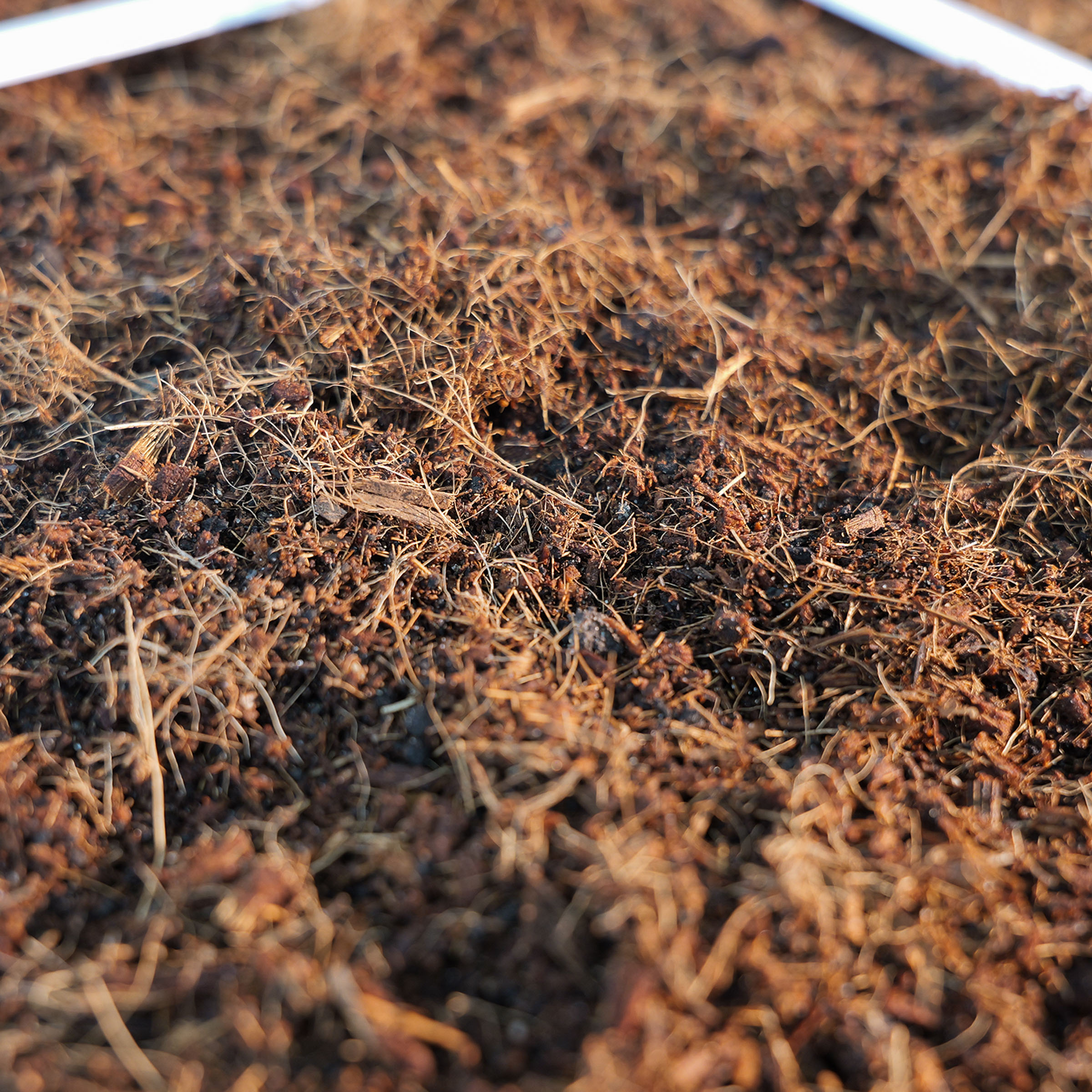
Then a coir specialist told me: 'What you need, Jelle, is coarser fibre - ideally with small pieces of coconut husk mixed in. That keeps the mix airy, and the coarser fibres stop the water from wicking all the way to the top, so it settles at the right level.'
That was the solution. When we tested that mix, it did exactly what we wanted: the mix became evenly moist without getting too wet, and remained airy enough for the roots.
That last point is very important, because plants also breathe through their roots. In a mix that is too compact or too wet, they can't do that and will start to rot.
That was the solution. When we tested that mix, it did exactly what we wanted: the mix became evenly moist without getting too wet, and remained airy enough for the roots.
That last point is very important, because plants also breathe through their roots. In a mix that is too compact or too wet, they can't do that and will start to rot.
MM cocopeat mix: with pieces of coconut husk.
Where does our cocopeat come from?
Coconut coir mainly comes from India and Sri Lanka, where coconuts have been grown and processed on a large scale for around 40 years. The fibres come from the husk, so they are a by-product of coconut production, and they have been reused as a peat substitute for decades.
But as we mentioned earlier, not every supplier produces fibres suitable for our raised beds, where you grow plants year after year.
We eventually found two: one in India and one in Sri Lanka. Both companies are based in beautiful areas, treat their staff well, and hold all the necessary certificates. When you visit their websites and see the photos, you immediately think: yes, these are companies we want to work with.
But as we mentioned earlier, not every supplier produces fibres suitable for our raised beds, where you grow plants year after year.
We eventually found two: one in India and one in Sri Lanka. Both companies are based in beautiful areas, treat their staff well, and hold all the necessary certificates. When you visit their websites and see the photos, you immediately think: yes, these are companies we want to work with.
Advantages and disadvantages of cocopeat
The advantages:
First of all, it means we no longer need peat, which is extracted from peatlands that are thousands of years old. Coconut coir is a by-product of coconut production, and new coconuts grow on the palms year after year.
But the following advantages are at least as important for your Makkelijke Moestuin:
First of all, it means we no longer need peat, which is extracted from peatlands that are thousands of years old. Coconut coir is a by-product of coconut production, and new coconuts grow on the palms year after year.
But the following advantages are at least as important for your Makkelijke Moestuin:
- Cocopeat retains moisture extremely well and absorbs it easily. This is particularly important when using our water reservoirs.
- The coarse structure of the fibres - with small pieces of coconut husk mixed in - prevents the mix from becoming too wet and keeps it airy, so the roots can breathe properly.
- The blocks are compact and light and require very little packaging. If you're used to carrying heavy bags to your raised bed, this is much easier.
- The mix remains loose and is pleasant to work with.
- And finally, cocopeat doesn't leave your hands dirty. A small detail, but a lovely one.
Pleasant to work with and no dirty hands :-)
The disadvantages:
The disadvantages:
- The cocopeat is supplied as compressed blocks. This means you first need to soak and expand them before use. Place them in your raised bed, add plenty of water, and wait until the blocks have absorbed it completely so you can loosen the fibres. This takes a little time.
- Cocopeat contains no nutrients and no soil life to convert nutrients into a form your plants can absorb, so you need to add both yourself*.
*That is why we no longer sell the coir blocks separately, but as part of the complete Makkelijke Moestuingrond.
When should you use soil with cocopeat - and when shouldn't you?
If you garden with our water reservoirs, we now recommend using cocopeat with them.
Are you buying a new raised bed with a water reservoir?
We recommend filling it with Makkelijke Moestuingrond, because it works slightly better with water reservoirs.
Do you already have a raised bed with a water reservoir filled with the classic MM-mix?
Just keep using it. The only difference is that in summer, you occasionally need to check whether the top layer of MM-mix is drying out too much. If it is, water from above a few times.
At the start of the season, you can top up your mix with Makkelijke Moestuingrond instead of a bag of MM-mix. Coconut coir breaks down much more slowly than the compost and wood fibres in MM-mix, so the amount of cocopeat in your raised bed will gradually increase.
Do you use a raised bed without a water reservoir that already contains MM-mix?
Keep it as it is. You can also top it up with the new garden soil at the start of the season. You will only need a few blocks, which is easy enough to manage. MM-mix and Makkelijke Moestuin Soil work perfectly well together.
Do you use a raised bed without a water reservoir that is still empty?
We recommend the regular MM-mix. It works just as well in raised beds without water reservoirs and is much easier for you.
Are you buying a new raised bed with a water reservoir?
We recommend filling it with Makkelijke Moestuingrond, because it works slightly better with water reservoirs.
Do you already have a raised bed with a water reservoir filled with the classic MM-mix?
Just keep using it. The only difference is that in summer, you occasionally need to check whether the top layer of MM-mix is drying out too much. If it is, water from above a few times.
At the start of the season, you can top up your mix with Makkelijke Moestuingrond instead of a bag of MM-mix. Coconut coir breaks down much more slowly than the compost and wood fibres in MM-mix, so the amount of cocopeat in your raised bed will gradually increase.
Do you use a raised bed without a water reservoir that already contains MM-mix?
Keep it as it is. You can also top it up with the new garden soil at the start of the season. You will only need a few blocks, which is easy enough to manage. MM-mix and Makkelijke Moestuin Soil work perfectly well together.
Do you use a raised bed without a water reservoir that is still empty?
We recommend the regular MM-mix. It works just as well in raised beds without water reservoirs and is much easier for you.
How do the cocopeat blocks work?
The blocks are made of compressed coconut coir. They are completely dry, so you need to wet them. The blocks then expand and the fibres loosen.
The easiest method is to place them on top of the water reservoirs, because water is also drawn up from below through the wicks. This gives the blocks water from both above and below.
Once all the fibres are loose, add the plant food and worm castings and mix everything together thoroughly. Then place the grid on top and you're ready to sow.
It takes a little time, but is quite enjoyable:
The easiest method is to place them on top of the water reservoirs, because water is also drawn up from below through the wicks. This gives the blocks water from both above and below.
Once all the fibres are loose, add the plant food and worm castings and mix everything together thoroughly. Then place the grid on top and you're ready to sow.
It takes a little time, but is quite enjoyable:
To turn the blocks into loose cocopeat, first soak them with plenty of water.
See the detailed step-by-step instructions here.
See the detailed step-by-step instructions here.
Frequently asked questions
Can I use coir blocks from a DIY shop or garden centre in my raised bed?
We strongly advise against it. Standard coir blocks are not buffered, often contain too much salt, and have a texture that is too fine for healthy roots in the long term.
They also come without plant food or worm castings, so your plants won't grow as well in them.
We strongly advise against it. Standard coir blocks are not buffered, often contain too much salt, and have a texture that is too fine for healthy roots in the long term.
They also come without plant food or worm castings, so your plants won't grow as well in them.
What if the cocopeat dries out completely? No problem. Fill the water reservoir and you will notice that the cocopeat quickly becomes moist again via the wicks. If you want to speed things up, you can also add some water from above.
How long does cocopeat last? Coconut coir hardly decomposes. That is why Makkelijke Moestuingrond remains loose and airy for years and never needs replacing. At most, you will need to top it up occasionally.
You do need to replenish the plant food regularly, for example after harvesting a square before planting a new vegetable. During the growing season, vegetables that remain in a square for a long time - such as tomatoes - need feeding every four to six weeks. The free Makkelijke Moestuin app will remind you.
Should I add perlite to the cocopeat? No. The coarse texture and pieces of coconut husk already provide enough air. We do recommend perlite when using regular MM-mix in a raised bed with a water reservoir.
How long does cocopeat last? Coconut coir hardly decomposes. That is why Makkelijke Moestuingrond remains loose and airy for years and never needs replacing. At most, you will need to top it up occasionally.
You do need to replenish the plant food regularly, for example after harvesting a square before planting a new vegetable. During the growing season, vegetables that remain in a square for a long time - such as tomatoes - need feeding every four to six weeks. The free Makkelijke Moestuin app will remind you.
Should I add perlite to the cocopeat? No. The coarse texture and pieces of coconut husk already provide enough air. We do recommend perlite when using regular MM-mix in a raised bed with a water reservoir.
Can I use cocopeat in raised beds without a water reservoir? Yes. Just bear in mind that you will need to water it regularly yourself.
Why do you supply the cocopeat in Makkelijke Moestuin Soil as compressed blocks rather than loose fibres? Compressed blocks are compact. Your parcel is much smaller than it would be with bags of loose mix, which means less packaging, less transport, and no heavy pallets. You do need to loosen the blocks yourself in your raised bed, which takes a little longer than emptying a bag.
What is the difference between untreated coconut coir and fibres that have been rinsed and buffered? Rinsing removes salts from the coconut coir and improves its acidity (pH). Buffering fills the fibres with calcium, so they don't absorb the nutrients you add later. Untreated or merely rinsed coconut coir has too high a salt content and competes with your plants for nutrients, damaging the roots and preventing your plants from growing properly.
What is the difference between untreated coconut coir and fibres that have been rinsed and buffered? Rinsing removes salts from the coconut coir and improves its acidity (pH). Buffering fills the fibres with calcium, so they don't absorb the nutrients you add later. Untreated or merely rinsed coconut coir has too high a salt content and competes with your plants for nutrients, damaging the roots and preventing your plants from growing properly.
Is Makkelijke Moestuin Soil organic?
No, because it isn't certified organic. Certification is expensive and, for coconut coir, doesn't tell you very much. Coconut palms grow naturally, usually in tropical coastal regions, on small family farms and without pesticides or artificial fertilisers.
No, because it isn't certified organic. Certification is expensive and, for coconut coir, doesn't tell you very much. Coconut palms grow naturally, usually in tropical coastal regions, on small family farms and without pesticides or artificial fertilisers.
Our coir supplier does hold two certificates that say something about this: RHP and OMRI Listed.
RHP is an independent Dutch quality standard that guarantees the product is safe for growing vegetables: it contains no harmful substances and has the correct pH and composition.
OMRI is an American organisation that assesses whether a product is suitable for organic growing. An OMRI listing doesn't mean that the cocopeat mix itself is certified organic, but it does mean you can use it when gardening organically.
Does your cocopeat mix have anything to do with palm oil?
No, nothing at all. Coconuts and palm oil come from two completely different trees.
Palm oil comes from the oil palm, which is grown in large monocultures in South-East Asia, and that industry rightly has a poor reputation.
Coconuts grow along tropical coastlines on small family farms in India and Sri Lanka.
The fibres in our cocopeat mix are a by-product of the coconut: the husk that would otherwise be discarded. The word 'palm' is the only similarity.
RHP is an independent Dutch quality standard that guarantees the product is safe for growing vegetables: it contains no harmful substances and has the correct pH and composition.
OMRI is an American organisation that assesses whether a product is suitable for organic growing. An OMRI listing doesn't mean that the cocopeat mix itself is certified organic, but it does mean you can use it when gardening organically.
Does your cocopeat mix have anything to do with palm oil?
No, nothing at all. Coconuts and palm oil come from two completely different trees.
Palm oil comes from the oil palm, which is grown in large monocultures in South-East Asia, and that industry rightly has a poor reputation.
Coconuts grow along tropical coastlines on small family farms in India and Sri Lanka.
The fibres in our cocopeat mix are a by-product of the coconut: the husk that would otherwise be discarded. The word 'palm' is the only similarity.